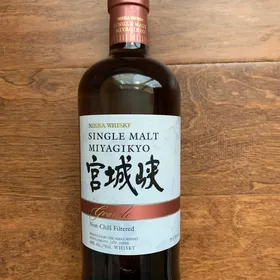
Color: Pale straw. Aroma: Gentle malt sweetness, fresh banana oil, and a heavy peat bitterness. Malt, fruitiness, soft smokiness, potent peat, and rich aged notes. Palate: Medium body, full-bodied. Bitter chocolate, a slight burn, smoke, leather, and a faint saltiness. Finish: Woody with a hint of oak sweetness. This is a bottle from Nikka's "Grande" series, designed to emphasize the distinct character of the Yoichi and Miyagikyo distilleries. The Yoichi distillery is known for its traditional Scottish coal-fired pot stills, which give its single malts a powerful, coke-like character. It is also the only Japanese distillery to exclusively use new oak casks, which are charred before use to impart a smooth, sweet flavor and add woody, vanilla notes. The Yoichi distillery's character is thus defined by woody smoke and heavy peat. The "Grande" version, compared to the standard, contains a larger proportion of new oak and heavily peated whiskies. After tasting this, I question everything I thought I knew about Scotch. If Masataka Taketsuru's whiskies are truly authentic "Scotch style," then modern Scotch has evolved significantly. To taste 1918-era Scotch, one might need to try Yoichi. The distillery's adherence to coal-fired stills and charred oak is understandable, as peat is abundant in Scotland, historically leading to direct-fire heating and peated malt drying. This process imparts a smoky aroma, aiming to replicate the unique "peat smoke" of Scotch whisky. The Longmorn distillery, where Taketsuru trained, also used coal-fired direct distillation (until 1994) and its smoky essence influenced Torii and Taketsuru's differing philosophies. Nikka and Suntory differ significantly: Suntory's founder aimed for a flavor profile suited to Japanese palates, while Nikka's founder sought authentic "Scotch style." Suntory focuses on mellow, rounded aromas with subdued smoke, while Nikka, following Scottish traditions exemplified by Longmorn, produces heavily peated spirits. Both Torii and Taketsuru were crucial to Japanese whisky's development, with Taketsuru hailed as the "Father of Japanese Whisky." His journey began in 1918 when he was sent to Scotland to study whisky production. He trained at Longmorn and Hazelburn distilleries and married Jessie Roberta Cowan in 1920, who became Rita Taketsuru. Their story inspired a popular Japanese morning drama in 2014, leading to depleted stocks and the discontinuation of age-stated Yoichi and Miyagikyo bottlings in 2015. After returning to Japan, Taketsuru's plan for domestic whisky production with Settsu Shuzo was halted by WWI. He then worked for Kotobukiya (Suntory's precursor) as the manager of the Yamazaki Distillery. However, differing views on production and flavor led him to leave in 1934. He established Dai Nippon Kaju Co., Ltd. (Nikka's predecessor) in Yoichi, Hokkaido, chosen for its resemblance to Scotland. Due to Scotch regulations requiring a minimum of three years' aging, he initially sold apple juice and apple brandy. In 1940, the first whisky, Nikka, was released. In 1969, he founded the Miyagikyo Distillery in Sendai, focusing on a Lowland Scotch style. Nikka was acquired by Asahi Breweries, Ltd. in 2001.
Yoichi
Yoichi Grande
3.88 Decent
Whiskey Japanese Whisky Japan 48% ABV
Tried it?
How was this pour?
Score this bottleRating a bottle takes an account, so your scores follow you and count towards the number everyone else reads.
Reviews
Showing the most detailed of 1 parsed reviews.
Kenneth David
3.5
Tastes like this
Same style and price bracket, best rated first.