After learning that my bottle of Amrut Fusion wasn't a genuine Indian whisky, I needed a replacement to introduce me to the category. Fortunately, this one was a gift. I might have otherwise chosen another Amrut, or perhaps Rampur or Paul John. I hadn't heard of this until recently, so it was a lower priority. However, I've observed its increasing availability on shelves throughout my state, so now seems like an appropriate time to try it. Nose: Caramel-dipped apple. Brown sugar and molasses. Raisin. Grilled pineapple. Coconut. Roasted cashew. Vanilla frosting. Black pepper and cocoa. Palate: Vanilla, malt, and toffee. Red hot cinnamon candy. Roasted cashew, almond, macadamia. Apricot and golden raisin. Banana and coconut. Mango and gala apple. Saltwater taffy. Black pepper and cocoa. Finish: Caramelized apple/apple cider. Golden raisin and apricot. Banana. Toffee. Macadamia and walnut. Sugar cookie. Red hot cinnamon candy, black pepper, cinnamon, cocoa, and oak. Moderate length. A solid finish. I'm surprised by how much I enjoy this. It offers a delightful, tropical profile with some hints of youth. These are mostly concealed by a rich and distinctive flavor. While Amrut Fusion contains Scotch components, I can recognize similarities in the profiles and begin to form my expectations for Indian whisky. It's very good. Before whisky, I primarily drank rum. I now find that genre to be harsh when opting for budget options and cloyingly sweet even in higher-quality selections. I'll explore rum again later. What I find interesting about Indian whisky is that it fills that rum flavor niche in a format I find more appealing and accessible. This isn't entirely unexpected, given the climate conditions. This is an excellent starting point for my Indian whisky exploration. As it was a gift, I checked the price at my local store, as I always consider value for money. At $50, this 46% triple cask finish delivers. I would purchase it myself. I'm giving it a 3.75, adjusted to 4.0 considering the value. Well done to the producer for this accomplishment.
Indri Trini The Three Wood Indian Single Malt
Whiskey World Whisky India No age statement 46% ABV
Tried it?
How was this pour?
Score this bottleRating a bottle takes an account, so your scores follow you and count towards the number everyone else reads.
About this bottle
Indri, a malt distillery in Indri, Haryana, is one of three distilleries in Northern India under the Piccadily Distillers group. This single malt is crafted from indigenous six-row barley sourced from Rajasthan. After distillation, it ages in three distinct barrel types: ex-bourbon, French red wine, and PX sherry. The blended whiskies are bottled at 46% ABV, with no chill-filtration or added coloring. Following its release in India, the UK, Europe, and Australia, this whisky was launched in the US in September 2022, retailing for $55.
How it tastes
Measured across 14 flavor axes. Tap a note to find other bottles that lead with it.
Reviews
Showing the most detailed of 26 parsed reviews.
A vendor I work with gave me a bottle for the holidays. They claimed it was an excellent everyday drinker. While I appreciate the gift, the phrase "everyday drinker" gave me pause. Who should be drinking alcohol daily? Why would any spirit be considered an everyday drinker? A bag of coffee called an "everyday drinker" makes sense. A store-bought Peet's is an everyday drinker. Okay, I'm done with my tangent. Let's get to this one. Amrut and Paul John are among my preferred whiskeys, both originating from the Indian subcontinent. I wasn't aware of any other Indian whiskies until I heard great things about Indri Dru Cask Strength. This is their entry-level offering—not intended to be as potent as the Dru—which likely wouldn't still match a Cask Strength version of Amrut, given Amrut comes from a hot region while Indri is from Haryana, leading to greater temperature swings. Floral notes and some oak are present. It's definitely young, but the Haryana heat is noticeable in the oak's influence. It's just not as prominent as the Goan Amrut or the Texan Garrison. Cereal notes and fruity berries are also detected. Nothing too controversial. But also nothing particularly remarkable. It's almost like a Speysider, with a bit more oak. Still, it shouldn't be labeled an "everyday drinker"
I acquired the 43% ABV version while on holiday in Goa, India. This whisky truly exceeded my expectations. Aroma: Upon smelling it, I'm reminded of a large fruit basket. I can detect dried fruits, a bit of apple, dark raisins, and a subtle hint of ripe pineapple. There's also a lovely touch of chocolate! Surprisingly, it's not pungent on the nose; instead, I notice delicate flavors of plum and vanilla. Adding a spoonful of water brought out some floral notes. Taste: When I take a sip, the whisky tastes of papaya and abundant dried fruits, with a slightly oily texture. The sweetness is balanced by a spiciness akin to cloves and cinnamon. The mouthfeel is rich and satisfying. Finish: The highlight? The finish! After swallowing, the papaya flavor lingers, accompanied by a strong spice, possibly cloves. It's a slow, unhurried finish that warms me as it goes down, with the spicy sensation lasting for about a minute. Overall, the Indri Trini whisky offers a delightful fruity aroma, a complex taste, and a memorable finish. I'm well on my way to finishing the bottle and will definitely purchase the "DRU" cask strength version.
An above-average single malt, quite similar to a single malt Scotch. I detect flavors like honey and vanilla, with absolutely no peat, salt, or iodine notes. It's good but truly not special. Where I live, it costs around $60-$65 USD, and I can obtain and have obtained superior single malt Scotch for the same or less money. I will certainly finish the bottle and don't regret the purchase at all; I'm glad I tried it, but I don't anticipate buying another bottle anytime soon. If price were not a factor and I wasn't comparing it to anything else, it would honestly be closer to a 3.75 or 4. However, considering its price point locally and its competition within the single malt whisky category, the value proposition reduces its rating by at least half a point.
This is an unusual one, and I'm undecided about it. It starts with the common notes of caramel, hay, and vanilla cereal, evolving into baking spice, red fruits, a touch of anise, and the finish brings more baking spice, a bit more oak, and what another reviewer described as grassy roasted coconut. The finish is the most intriguing aspect, but it doesn't make it exceptional. What does make it great is the price point of around $40 and the novelty of trying a malt from outside Scotland. I might revisit it.
This spirit sits between offerings from Paul John and Ireland, presenting a rich profile of tropical and dark fruits. Smell: Raisins, Honey, Pineapples, Strawberries, Guava, Maple Syrup, Brown Sugar, Walnuts, Tangerines, Mangoes Taste: Guava, Tangerines, Passion Fruit, Raisins, Milk Chocolate, Coconuts, Bananas, Golden Kiwis, Almonds Aftertaste: Blackberries, Raisins, Honey, Plums, Grapefruit
20 more reviews were collected for this bottle. The longest ones are shown first.
Tastes like this
Closest flavor profiles across the whole catalog.
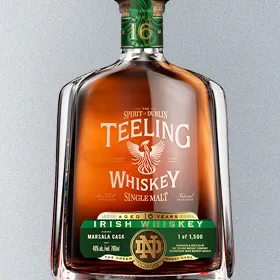
Teeling x Notre Dame 16 Year Single Malt Marsala Cask Finish (Phoenix Legends Series No. 2)