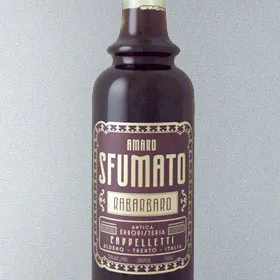
Appearance: Dark brown, nearly black. Very similar to the look of black coffee. Smell: Charred wood, bitumen, licorice, orange peel, anise. Taste & Mouthfeel: Arrives sweet with notes of burnt cola, toffee, and chocolate. Underlying hints of orange zest and cinchona. Deep and coats the mouth. Zucca shares similarities with some "alpine" amari like Braulio, but it's less herbal. It also resembles Cappelletti's Rababaro Sfumato, though that amaro is significantly smokier. The key components here are extract of Rheum palmatum (which imparts an asphalt-like smoky flavor) along with sweet licorice and orange oil. It also bears a resemblance to Cynar, but lacks its complexity, with the star ingredient dominating the profile. It's good as a digestif, especially when slightly warmed and served with a lemon or orange slice as a winter beverage. My only reservation with Zucca is its tendency to become cloying or excessively sweet after a while. On the bitterness scale for an amaro, it ranks relatively low, making it more immediately approachable but less captivating over time. While it's not an amaro I purchase frequently, I have bought several bottles over the years, indicating a definite appeal. “Good”: 84/100 (3.75 stars)
Zucca Rabarbaro
Liqueur Amaro Lombardia No age statement 30% ABV
Tried it?
How was this pour?
Score this bottleRating a bottle takes an account, so your scores follow you and count towards the number everyone else reads.
About this bottle
The recipe for Zucca Rabarbaro dates back to 1845, originating when a physician recommended rhubarb and herbs for Tilde Zucca's digestion. Her husband, Ettore, subsequently added alcohol to the mixture, which became a popular aperitif in Milanese and other European cafes. In the early 1900s, Carlo, a descendant of Ettore, established the Zucca Company to market the product. "Rabarbaro" translates to "rhubarb" in Italian and is the sole disclosed ingredient. The rhubarb root is sourced from China's Gansu province. Note: The product's proof was increased from 30 to 60 in Spring 2016, accompanied by a label update.
How it tastes
Measured across 14 flavor axes. Tap a note to find other bottles that lead with it.
Reviews
Showing the most detailed of 6 parsed reviews.
Presents a profile akin to an amaro such as Cynar, but with distinct rhubarb characteristics offering a mild fruitiness throughout. There's also a hint of smoke on the aroma and finish. It won't be my preferred amaro, yet it's quite enjoyable and will serve as a welcome diversion during the summer.
Good for mixing, with a 0.5 addition. Quite potent. Not excessively rhubarb-flavored but very tasty. Can be prepared with a 1:1:1 ratio.
A perfect combination of smoky fruit and amaro with cola-like notes. An excellent after-dinner drink.
Top-tier bitters. Lovely flavors.
Yummy. A sweet, mild, syrupy rhubarb amaro.
Tastes like this
Closest flavor profiles across the whole catalog.