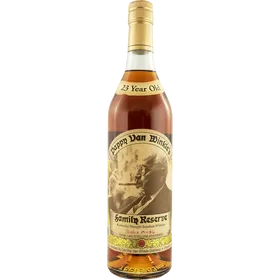
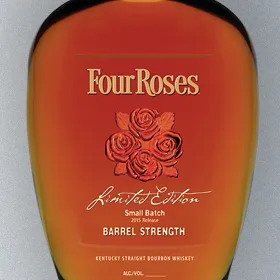
You know, sometimes fate is kind. Better yet, a companion gets fortunate, and you get to enjoy the spoils without earning them. Sometimes events unfold in a peculiar manner. There's more to this tale than can be recounted here, but to put it concisely, a new visitor center opened at the Four Roses distillery this year. The governor of Kentucky was among the initial speakers on the inaugural day. Attendees were welcomed to celebrate a new chapter for the brand's century-plus heritage, and guests had the chance to acquire a special single barrel bottling. For those familiar with the distillery, it's not uncommon to encounter single recipe, single barrel, barrel strength releases. These have largely gone unnoticed (but that's no longer the case), and on this momentous day, several bottles were made available. They all originated from the OBSV recipe (high rye content, yeast strain V). Each had been matured for 20 years. While the exact quantity is unknown, roughly 20-50 barrels were designated and emptied for the occasion. So, I ponder - how many 20-year-old, single barrel bourbon bottlings are currently in existence? I'd rather not know the answer, but if I had any influence over the grand design of things, I'd suggest many. I lack such authority, which is probably for the best. Elijah Craig continues to offer their 18-year single barrel selections, and an individual known as VanWinkel has a 23-year bottling of a similar nature. Word has it that it hovers around 90 proof. This specific bottle - with an ABV of 58.1% (116 proof) - was aged in warehouse FS and resided on the third floor of six, right in the middle – a location where air circulation is theoretically minimal. Approximately 20 years later, let's explore its character. The aroma is dominated by oak. Surprised? It's exquisite, though, reminiscent of Wild Turkey's 17-year BiB Masters Keep. There's a scent of varnish. Notes of aged books, lamp oil, and dark tobacco are present. A sweet fragrance, again similar to tobacco, is detected, along with hints of royal icing. The taste? Much like the palate, there's an immediate, powerful, and penetrating sensation of tannins. It's rich with dark sugar but lacks the bitterness of molasses. A spice is present, evoking the sensation of tasting a dark cigar wrapper before lighting it. The oak is also noticeable and difficult for me to articulate, but I imagine it tastes like the interior of my dresser drawer, which is well over 20 years old and has witnessed countless arrivals and departures. It lingers persistently. The tip of my tongue still tingles an hour later. This might not be beneficial for my well-being. But, remarkable. At some stage, bourbon transforms from its raw ingredients into wood. This expression is far beyond the raw ingredient phase. If I had managed to sample a small amount and rub it on my hands, I might have detected corn and rye, but possibly not. Perhaps something closer to furniture polish. This possesses abundant spice, tannins, and a dark sugar that might resemble sorghum. It is absolutely magnificent - though perhaps not to everyone's preference. As someone increasingly drawn to scotch for its vast diversity (largely due to the variety of barrel types used for aging and finishing, as well as the peated malt, and the influence of the sea, among other factors), this still offers some extraordinary qualities that only time, water, grain, and former new wood can impart. For most scotch, that's not a desirable trait, as many barrels are reused or 'recharged' and have lost the chemical components that significantly contribute to bourbon's character. There you have it. My apologies for the extended commentary, and no - please don't attempt to profit excessively from this bottle if you possess one. Enjoy it. Reflect on its nature, what it represents as a whiskey, and what it doesn't. Appreciate the essence of liquid wood – mingled with water and organic compounds, sugars both simple and complex – in taste and texture. This is the origin point for virtually all whiskey (unless you age your malt in French Oak or ex-wine barrels), and it's truly impressive to witness the outcome. Share it with companions - just as a friend was generous enough to do with me. You won't regret the experience (unless, naturally, you end up disliking the taste of aged bourbon, in which case you've at least gained some self-understanding). Yes, and that concludes my thoughts. Cheers!
Four Roses
Four Roses OBSV 20 Year Visitor Center Private Selection
4.63 Exceptional
Whiskey Bourbon Kentucky 20 years 58.1% ABV
Tried it?
How was this pour?
Score this bottleRating a bottle takes an account, so your scores follow you and count towards the number everyone else reads.
Reviews
Showing the most detailed of 1 parsed reviews.
Dolly Anglin
5.0
Tastes like this
Same style and price bracket, best rated first.