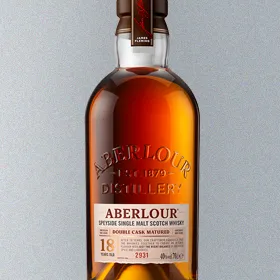
ABERLOUR SHOWDOWN Aberlour 16 Aberlour 18 I'm continuing to explore whiskies in my collection that I haven't yet reviewed. In this instance, I wrote a brief assessment of the Aberlour 18 over a year ago, so it feels appropriate to examine it alongside its younger counterpart. I previously had the 12-year-old expression and intended to include it, but it was apparently finished some time ago. Then, I considered adding a couple of bottles of Aberlour A'Bunadh, but since those are bottled at cask strength, they don't quite align with these and are better reviewed separately. Aberlour describes these whiskies as having undergone 'double cask maturation,' initially aging in American oak casks before finishing in sherry oak casks. Aberlour 16 A clear sherry-influenced mahogany hue; Pantone 153. The aroma is somewhat subdued, particularly when contrasted with the 18-year, but still offers notes of Luxardo cherries, chocolate, nutmeg, and a gentle, cool spearmint. The palate presents some toffee and orange bitters, leading to a modest spice with low alcohol content, and a hint of espresso bitterness in the short to medium finish. I acquired this, my sole bottle of the 16, along with the 12, because I was fond of the cask-strength A'Bunadh and already appreciated the 18. To be honest, when I bought them, I didn't notice that both the 12-year and 16-year were bottled at only 40% ABV. I've expressed my disapproval in several reviews regarding the emphasis on economics that this minimal ABV represents. The 16-year-old can be found for approximately $120, making it costly for a 40% ABV spirit. It's a sweet and accessible expression of a solid sherry-casked whisky. But would I purchase it again? No. Score: 3.5, considering the poor value. 40% ABV. Batch AB16-1-19 Aberlour 18 The color is virtually identical to the 16-year, despite two additional years of aging; Pantone 153. The nose is richer and more developed than the 16: molasses, toffee, orange bitters, dark butterscotch, and mulled cider. The palate is significantly more expansive than the 16-year, with more pronounced burnt orange and toffee flavors, along with sweet molasses notes from the nose. The finish exhibits a pleasant espresso bitterness, similar to the 16, but more robust. The higher ABV is evident. The 18 can be found for around $200. Would I buy it again? Yes, if cost isn't a concern. Score: 4.25. 43% ABV. Unlike the 16-year, there is no batch number; this is an older bottle with the previous label, which did not include batch numbers. I'm unsure if newer bottlings feature batch numbers. When compared to the 16-year-old, I would guess that the 18-year-old's increased ABV contributes as much, if not more, than the extra two years of aging (which is relatively minor in the cool and damp Scotch whisky aging environment). This, in turn, raises the question of the purpose of a 16-year at the same 40% ABV as the 12-year, positioned between the 12 and the 18. For most age-stated Scotch whiskies, a 10- or 12-year represents the entry-level product. A bottling with 16 years of age is closer to 18 years than 12. Why offer the 16 at the same 40% ABV as the entry-level 12? Or, why offer (hypothetically) a 16-year-old at the same 43% ABV as the 18? From a branding perspective, neither makes sense to me. N.B.: All spirits were tasted neat in a Glencairn glass.
Aberlour 16 Year Double Cask Matured
Whiskey Scotch Highlands 16 Year 43% ABV
Tried it?
How was this pour?
Score this bottleRating a bottle takes an account, so your scores follow you and count towards the number everyone else reads.
About this bottle
Aberlour, meaning “mouth of the chattering burn” in Gaelic, is a distillery situated in Speyside at the confluence of the Lour Burns and the River Spey. This 16-year-old single malt Scotch whisky, originating from the distillery established in 1812, spends its maturation period in both ex-bourbon casks and oloroso sherry butts. It is presented at 86 proof.
How it tastes
Measured across 14 flavor axes. Tap a note to find other bottles that lead with it.
Reviews
Showing the most detailed of 50 parsed reviews.
Review #056 Type: single malt scotch Proof: 40% Comments: aged 16 years, matured in ex-bourbon American oak and sherry casks, this bottle was from batch no. AB16 2-21 Tasted after: first up Appearance (no score): Mahogany color. Swirling shows a thick line sticking to the glass, legs are slow to form. Smell: 17/20 The smell is subtle, but by far the best part. Vanilla and sugary caramel are most noticeable. Also detecting orange zest, nuts, and fruity pastries. It’s not complex, but I quite like how welcoming it is. Taste: 26/40 The first thing that came to mind upon sipping was how diluted this is. Like someone drank half the bottle and topped it up with water. What can be detected is mildly floral, with hints of red delicious apple, orange peel, oak tannins, and brown sugar. Admittedly my palate is adjusting as I sip more, but it’s still very unimpressive. End: 24/40 Medium-short finish. More dry oak tannins, noticeably drying my mouth, accompanied by mild chili pepper heat and cinnamon. With Water: I almost skipped this step as I think the distiller already did the work, but diligence requires a few drops. The chili pepper heat on the finish is intensified, now more apparent in the back of my mouth. There’s a new salty flavor that emerges as the finish develops also. Total: 67/100 Final thoughts: I’ve complained when reviewing bottles before about low ABVs and wished some had been left a few percentage points higher, but this is so muted it's something else entirely. This bottle is far too low in proof. That being said, this isn’t a bottle that I disliked. The flavors that are present are good and work well together, they’re just incredibly subdued to the point of being almost bland. If this were a $50 bottle I would have rated it higher, but for the price it’s just a poor purchase. Price: $102 Would recommend: no Would buy: no Scoring Legend: 96-100: The perfect dram, absolutely exceptional, divine, I will savor this bottle and make it last, 5 stars. 90-95: Near perfect, there is something truly special about this spirit, 4.75 stars. 85-89: Very good to amazing, almost the complete product, 4.5 stars. 80-84: Quite good, very enjoyable to drink, but doesn’t wow me, 4.25 stars. 75-79: Good, enjoyable but ultimately flawed, unlikely to purchase again, 4 stars. 70-74: A solid dram, but wouldn't go out of my way to get it, 3.75 stars. 55-69: Drinkable, 3.5-2.75 stars. Below 55: Suitable for cooking or direct contribution to the kitchen sink drain, 2.5 stars or less.
I've been savoring this bottle of Aberlour 16 for some time, enjoying a sip occasionally. It has become a favorite nightcap, a scotch I pour to relax while watching TV or reading. A recent acquisition of a Kirkland 17 Year Speyside prompted me to revisit this review as part of a side-by-side comparison. This whisky was enjoyed neat from a NEAT tasting glass. On the nose, the Aberlour presents a slightly mustier, earthier note of clay, ripe orchard fruit, figs, and vanilla bean compared to the soft and even more delicate Kirkland. Both exhibit minimal ethanol presence and effectively convey the complex and approachable character of a good Speyside single malt. On the palate, the Kirkland is drier than its aroma suggests, though far from dry. There's a pleasant integration of sherry fruits, brandied cherry, and ripe apples riding on a wave of breakfast cereal. The Aberlour is even drier, richer, and earthier with notes of dark chocolate. To use a metaphor, the Kirkland is like browsing the stacks of a public library, while the Aberlour is like relaxing in the leather seating of a private library. Very similar, yet meaningfully distinct experiences. The Aberlour 16 is smooth, sophisticated, subdued, and multidimensional. It delivers a medley of fruitcake, baker's chocolate, and wet cereal grains in a very cohesive and enjoyable package. Aberlour 16 is an excellent scotch whisky, even if its near $100 price point doesn't make it a bargain. It justifies its cost.
This is a balanced selection leaning towards a more Sherry character from Aberlour. The double cask maturation truly stands out in the 16, and it feels like a more successful realization of the distillery's goals compared to the 12 year old offering. The 12 felt like an unfinished piece of art. At 16, the artwork feels truly complete and unified. Naturally, this comes with a higher price, but it's justified for those seeking a scotch with Sherry characteristics. Deep dark and rich fruits, spiciness, some woody notes, but beautifully balanced so that no single element overpowers the senses. Sweetness is just right. Very drinkable, smooth, and complete in a sense. Great stuff.
The aroma carries more heat than anticipated for 40% ABV. Careful sniffing reveals oak, red berries, and crème brûlée. I anticipate a pleasant aroma for this age, but it's not guaranteed and is appreciated when it occurs. The palate is smooth and inviting, echoing the crème brûlée and overripe red berries from the nose, but introduces a burst of powdered dark chocolate, Jordan almonds, and warm caramel. There isn't a distinct close; the caramel flavor just fades, leaving a slight tingle on the tongue. I appreciate the aroma and flavor profile; it's very approachable and easy to drink. If you encounter this at a bar, it's a safe, solid, and sensible choice, and I endorse it.
Smell: sugary berries, wood, vanilla, malt. Taste: mirroring the smell, velvety, rich, and approachable. Verdict: I would opt for another spirit over this one given its present cost. For $120 in my locale, it's only 40% ABV, chill-filtered, and artificially colored? That's not a bargain. Fortunately, I acquired it for $70. At its present price point where I am, numerous superior whiskies are available. A 3/5 star rating for value versus flavor. This is an excellent spirit for newcomers to scotch. It's not overly intricate and goes down smoothly.
44 more reviews were collected for this bottle. The longest ones are shown first.
Tastes like this
Closest flavor profiles across the whole catalog.