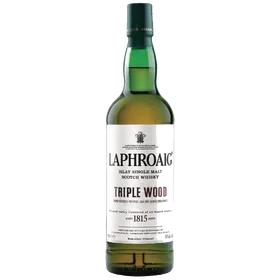
The aromatic bouquet of the whiskey is filled with notes of peat coals burning in the fireplace, nuances of coconut and banana. The whiskey's taste is rich, deep, complex, smoky, velvety, with attractive and mysterious delicate notes of confectionery and a very long aftertaste with hints of smoke and spices. The creation of the amazing "Laphroaig" Quarter Cask whiskey was inspired by small barrels, which were often used in the 19th century to store and transport Scottish whiskey through the glens on packhorses. With the development of industry, they went out of use, replaced by large barrels, which were more economically viable and gradually became the norm. However, both producers and whiskey lovers know that the contact between barrels and maturing spirits is very important. Laphroaig masters rightly noted that the small size of the barrel provides up to 30% more contact with the wood compared to large barrels used today, which significantly accelerates the whiskey aging process. Therefore, the distillery restored the Quarter Cask and moved whiskey from large barrels into them for aging. The result surprised and pleased both the producer and whiskey connoisseurs. The additional influence of wood created a soft sweetness and velvety sensation, while preserving Laphroaig's unique intense peaty character. At the same time, in the very long aftertaste, sweetness and peaty notes harmoniously combine. "Laphroaig" Quarter Cask is the owner of a huge number of gold, silver, and even platinum medals received at prestigious international specialized competitions. In 2012, the whiskey took second place in the prestigious "Whisky Bible Awards" rating in the category of the best non-age-statement Scotch single malts. The Laphroaig distillery was founded by Alex and Donald Johnston in the early 1800s. Until 1954, the distillery remained in the family's possession but was bequeathed to Bessie Williamson, who had worked for many years as a secretary. Overnight, Ms. Williamson became the most important woman in the whiskey industry. She sold the distillery to Long John Distillers, and she herself retired in 1972. True, Ms. Williamson was not the only female manager of Laphroaig; before her, the distillery was managed by Katerina Johnson and her sister Isabella. Despite the fact that, according to experts, the PPM level (the amount of phenol particles - a unit of measurement for the "smokiness" of whiskey) in modern Laphroaig is noticeably lower than 25-30 years ago, this whiskey, saturated with the smell and taste of the sea, is considered one of the most powerful and recognizable among all island whiskies. Laphroaig is one of the few distilleries that have preserved a traditional malting floor, which ensures the consistency and recognizability of its products. Due to its specific taste and aroma, reminiscent of medical preparations, Laphroaig was sold in pharmacies during the Prohibition in the USA. Prince Charles loves this whiskey, which is why the labels are adorned with the inscription "Supplier to the Royal Court" - an honor that many strive for, but few achieve. The smokiest is the 10-year-old whiskey; as the aging increases, the smokiness decreases, but the drink becomes deeper and more diverse. The so-called cask strength in the official Laphroaig bottling is actually standard but simply increased.
Laphroaig Quarter Cask
Whiskey Scotch Islay No age statement 48% ABV
Tried it?
How was this pour?
Score this bottleRating a bottle takes an account, so your scores follow you and count towards the number everyone else reads.
About this bottle
Recalling 19th-century practices, this bottling involves placing 5- to 11-year-old whiskies into smaller, 125-liter casks, which are one-quarter the size of a Sherry butt. This was historically a cask size that two individuals could transport to market for sale. The increased surface area of liquid in contact with the wood imparts additional vanilla and oily characteristics.
How it tastes
Measured across 14 flavor axes. Tap a note to find other bottles that lead with it.
Reviews
Showing the most detailed of 50 parsed reviews.
I happened upon this bottle and am pleased I did. I was at a lounge, and after surveying their back bar, I saw that Laphroaig Quarter Cask was the only offering not intended for casual mixing. I requested an ounce neat, and that marked the beginning of my experience. I'm not extensively familiar with peated scotch, but I have sampled Laphroaig 10yr and a few others. While I can't precisely recall my L10 experience, I had a general idea of what to anticipate from Laphroaig. The aroma began as I remember the L10, but as I let the LQC sit, it evolved into a very distinctive experience. I detected peat, smoke, and brine notes initially, which developed into sweet honey floral notes, and then progressed further with berry and cherry notes. The palate is a rich sensation that coats your mouth with a spicy initial impact. I appreciate the spicy tingle that arises. A well-balanced blend of smoke and floral sweetness follows. It's difficult to articulate, but I believe the sweetness helps to temper the intensity of the smoky peat. The finish is smooth. I find the 98 proof point to be ideal. It's complete, effectively carrying all the flavors. The smoky, peaty, and salty notes detected at the beginning reappear at the end like a gentle breeze fading over the landscape. Laphroaig excels in its branding. The bottle and packaging are classic. I appreciate the inclusion of a small booklet detailing how to claim a square foot of Islay. It's quite intriguing for a Canadian residing on the prairies, far from any ocean. This will be a bottle I revisit often. 9.25/10
Comparing this to Laphroaig 10, my thoughts are a bit jumbled. Nose: Compared to the 10, this has a substantial oak presence on the nose. Sharp wood and vanilla harmonize with a peaty, smoky character. There's a notable salinity, but the dominant feature is the wood. Spicy, baking spice, nutmeg notes are present. The 10 is more phenolic and rubbery, like fresh Play-Doh. Returning to this after smelling the 10 reveals notes of tobacco, leather, and pine/cedar. Palate: More wood is evident here as well. Burnt sugar, warm toasted oak, cinnamon, sweet vanilla, and caramel. The peat is certainly present, but emerges more during the transition to the finish. Hints of green apple are detected, though I might be mistaken. More peat appears as I continue to savor it, but is there a subtle hint of light red fruit sweetness? A faint maritime breeze is perceived. A hint of burning wet tree moss as it moves towards the finish. The 10 has more fresh malt character and medicinal peat elements. The smoke and brine are more prominent in the 10. Finish: Rubbery phenols are most apparent here; oak tannins are significantly more pronounced than in the 10, as anticipated. Drying and tongue-coating. The 10 has more salinity. The 10 offers more ash, phenols, and earthy peat fire on the finish.
June 3, 2023 - Sampled a blind lineup of 10, 10S, QC, and Lore. The samples were in colored Glencairn glasses. My ranking for the nose was 10, 10S, Lore, QC. My partner ranked Lore first, followed by 10, 10S, QC. We were wrong about 75% of the time when guessing which was which. The 10 was mistaken for Lore and QC. Lore was mistaken for 10 and 10S. For me, the 10 and 10S advanced from the first head-to-head. My partner chose Lore and 10. My order: 10, 10S, Lore, QC Partner's order: 10, Lore, 10S, QC QC was ranked last by both of us, and by a significant margin. Perhaps the 43% ABV of the 10, compared to the 48% of the others, made it seem better balanced. The 10 has a lively nose and flavor, and it holds its own within the family lineup. Conclusion - The 10 is the flagship release for a valid reason and might be the best value in Islay. Lore isn't worth the extra cost compared to the 10. Quarter Cask, which I expected to be a standout, is not something I would purchase.
Laphroaig 10 year is probably the single malt I like best right now, so I was eager to try another one from them. This appears to be the next logical choice. I'm trying this dram while also having a bit of the 10 year and some Bowmore 15 for a fruity comparison. The aroma is like a savory roast chicken meal with wood shavings. Smoke is there but not as strong as the salty, meaty scents. The taste is rich and intense, a bit peppery and still quite savory. There's no caramel, vanilla, or sweetness here like in the 10 year. The finish is very long and intensely oaky with tannins. It begins like a Chardonnay and finishes like a used tea bag. It makes you want another sip. I'd still prefer the 10 year, but this is quite good. Enjoy this one with your Sunday meal and save the 10 year for after.
This last pour has been in the bottle for a while, so the flavor and aroma might be slightly altered, but it's still good, and it's still Laphroaig. Nose: strong peat smoke, creosote, a significant amount of brine. Pleasant warm oakiness, a slight hint of lemon vanilla cream, baking spice, and candied ginger and cinnamon. Palate: a fairly strong vanilla that softens and becomes creamier as your palate adjusts. Sharp woody oak tannin, classic Laphroaig medicinal notes. I do appreciate how the extra wood contact interacts with Laphroaig. Charcoal and sea spray. Finish: moderately long, with a prominent oak profile; the peat emerges later in the finish with its phenols.
44 more reviews were collected for this bottle. The longest ones are shown first.
Tastes like this
Closest flavor profiles across the whole catalog.