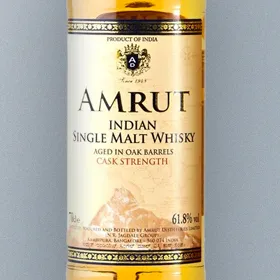
My prior experiences with Amrut, limited to three bottles, have all been excellent, though focused on fruit. I have high expectations for this one. Nose: A powerful peat aroma is present. It doesn't smell sweet and has considerable smoke. Unlike Arran's Machrie Moor, this has a strong character. There's a hint of mint and malty richness. However, because it lacks fruitiness, sweetness, salt, or sea brine, the nose isn't exceptionally complex. The Amrut Fusion's nose is more intricate and slightly more pleasing. Palate: This is bold! There's some sweetness, but also significant peat. The herbal, medicinal quality of the peat is prominent, along with a large amount of tobacco and some of the rugged salt and brine that the nose lacked. There's a touch of fruit, but it's hard to identify. The sweetness is rather general, with even a hint of cinnamon sugar. It's less balanced than the Fusion, but the peat presence is enjoyable. It still possesses good complexity and solid balance, despite being somewhat unrefined. There's a hint of wet wood, but it's not unpleasant. I detect a tart note, similar to what I find in other Amrut bottlings, as well as Kavalan and American Single Malts. American single malts often turn this into a yeasty profile, while Southeast Asian spirits lean towards tropical fruitiness. Finish: The peat lingers, along with some sweetness, herbal medicinal flavor, and a touch of tartness. It's a decent finish, though the palate is more remarkable. I anticipated this would be similar to a fruitier Talisker due to its peat content (24 PPM), but it's much more assertive than either that or Caol Ila. It's less assertive than Ardbeg, but it does resemble a somewhat fruitier and less herbal Ardbeg Corryvreckan. I prefer this over Talisker 10 and Caol Ila 12. It's likely not as good as Ardbeg Corryvreckan or Uigeadail, but it's impressive. Well done, Amrut! The cask strength version is richer with more of a cherry sweetness. The cask strength also handles water well, making it difficult to decide which offers better value. I found this one to be more complex, but I really enjoyed the richer, fruitier profile of the cask strength, so I consider that the superior whisky. That said, this is an excellent whisky. It's close in quality to the Amrut Fusion, though I believe the Fusion is slightly better. Talisker and Caol Ila are rated at 16, while Amrut Fusion is at 18, so I'm giving this a 17. I could see it reaching an 18, especially since I can see Amrut Fusion reaching a 19. I must admit, despite my enjoyment of this, I remain somewhat disappointed by Amrut's pricing. It's not exorbitant, but how much can it cost to age whiskey for a few years in India? They couldn't have aged this for very long, and labor likely isn't expensive, so I assume the distillery is making a substantial profit. I'd be annoyed if the liquid wasn't so good! Furthermore, Kavalan is far worse when it comes to price gouging.
Amrut Peated Indian Single Malt
Whiskey World Whisky India No age statement 46% ABV
Tried it?
How was this pour?
Score this bottleRating a bottle takes an account, so your scores follow you and count towards the number everyone else reads.
About this bottle
The name Amrut comes from the Sanskrit word "Amrita," meaning "immortality" and referring to the nectar of the gods. This Peated Single Malt is one of five standard bottlings in the Amrut lineup, featuring a peat level of approximately 24 ppm.
How it tastes
Measured across 14 flavor axes. Tap a note to find other bottles that lead with it.
Reviews
Showing the most detailed of 39 parsed reviews.
Amrut is a reliable choice when purchasing a new bottle. Everything they produce is excellent, especially considering their first whisky was released in 2004. That said, this isn't the finest Amrut I've ever had, and it's not overly peaty. It's still a good whisky with some interesting notes. Bottled at 46% ABV (not to be confused with the Peated Cask Strength Amrut). Amber color. On the nose, it's so amazing that it earns a perfect score, elevating the overall rating of this dram. It starts with "naranjilla," a remarkable fruit found only in countries like Ecuador, where I reside. You might also know it as "Lulo." It's very tropical. Glazed pork, some medicinal notes, too. An IPA beer aroma, tangerine, and coffee. Citrusy. After the first sip, the aroma develops an olive oil note, spices, and cherry tomatoes. On the palate, it's a little disappointing. Vanilla, ashes, a bit earthy, lemon, and pineapple. Still a tropical yet peaty profile. Aftertaste has an explosive peat punch, but it fades quickly. Chili and salt. Overall, this is a good whisky but not a great one. Every Amrut I've had previously is superior to this one. The score is 85 out of 100 because the aroma is exceptional.
Bottle is 1/3 full. One of the best. Peat and butterscotch on the nose. Vanilla, smoke, oatmeal, cinnamon, roasted peanuts, "Amrut green pepper," and berries - in that order on the taste. The finish glides off into a smoky sunset with a medicinal note. Value: Received this as a Christmas gift from my wife and was underwhelmed; it soon became a favorite. I'm really enjoying the dynamics of Indian whisky. The price reflects the quality of the spirit, but I'd hesitate to pay around $85 for it. I will definitely keep it stocked in my cabinet and am looking forward to sharing it with friends. P.S. As the bottle depletes, floral notes begin to emerge and overpower the other flavors. 5.0 - Go buy all the stock you can find. 4.0 - Must buy at least one bottle before you die. 3.0 - Solid, must try at a bar or mooch from a friend. 2.0 - Didn't like it, but you might. 1.0 - You might have the palate of my dog, and he licks his own rear.
NOSE: Sooty peat, apricot, malty sweetness, vanilla, minerality, and some light herbal notes. It's so subtle coming from the glass that it's hard to discern much beyond the sooty peat and apricots, but when you get those noteworthy whiffs, it's pleasant. PALATE: Sooty peat, apricot, malty sweetness, vanilla, minerality, some light herbal notes, and a yuzu-like sweetness. The palate is almost an exact replica of the aroma, with a bit more sweetness, but it's so subtle and dominated by the sooty peat that it's difficult to truly extract much from it. FINISH: Medium-Long -> Sooty peat and lightly fruity sweetness with a soft graham cracker note, but again, there's just not much happening.
I'm consistently impressed with Amrut. The combination of India's climate, high-quality production, and innovation has resulted in exceptional products across various price points. This particular whiskey uses Scottish peat and North Indian barley. It ages for about 6 years in used bourbon barrels. Six years in India's heat is equivalent to 15-20 years in Scotland due to significant wood interaction. Aromas of burnt rubber and citrus. The taste is lightly smoky with strong fruity flavors. At around $70 USD, this is an absolute must-buy.
This is a wonderful whiskey, and my first from India. I'm eager to see if they are all this good. Nose: Smoked bacon with caramelized notes and a subtle earthy, peaty undertone. Palate: Tart summer fruits and vanilla. Finish: This is where the peat comes through, along with a hint of lingering smoke. It's peppery and spicy. It's pricier than my favorite Islay whiskies, but definitely worth trying.
33 more reviews were collected for this bottle. The longest ones are shown first.
Tastes like this
Closest flavor profiles across the whole catalog.