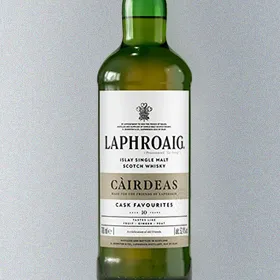
Last night, I was working outdoors during the lingering rain from hurricane Matthew here in central Virginia. The weather perfectly set the scene for an Islay scotch: gloomy, salty rain and strong winds (while working nights always tests my mood). It was the ideal time for a new Laphroaig. I decided to open this year's Friends of Laphroaig Cairdeas release, which was finished in Spanish Madeira wine casks and is a robust 103.2 proof. I purchased it for $75 in Virginia. To my surprise, opening the bottle didn't fill the living room with that distinct, beautiful Laphroaig smoke. As I poured a dram, I noticed a faint rose color tinging the usual golden appearance. I initially thought it was a reflection from the bottle label, but upon closer inspection, it's a subtle pinkish hue in my Laphroaig. Even after 15 minutes of resting and swirling, the nose doesn't offer much smoke. Strangely, it strongly reminds me of the 15-year-old Laphroaig, and not in a good way. There's also nothing prominent to replace the typical smoke. This is concerning. The first taste reveals the familiar Laphroaig smoke and a pleasant hit from the oak barrels. I detect a youthful spirit here. Regarding the wine cask finish, I only perceive subtle sweet fruits like strawberries and perhaps cherries. Whatever time it spent in these wine casks wasn't sufficient to add significant complexity. It replaced the usual oily and rich finish with a weaker, dry one. I truly enjoyed the 2013 port wood Cairdeas, which offered a wonderfully complex Laphroaig. Unfortunately, this version doesn't measure up. The finish is quite dry and very short. Even the burn from the high proof is absent, which some might appreciate, but I don't. It feels very uncharacteristic of Laphroaig. So, my initial impression is quite similar to the 200th-anniversary 15-year-old. It seems like a lighter Laphroaig, which isn't what I seek from this brand. Before anyone criticizes, I understand the challenge of creating an annual Cairdeas release with extreme depth, but they've achieved it before, so that's not entirely true. This is a departure from the usual, but I can't help but feel a bit let down. I still love Laphroaig, but I have to consider this one a disappointment. I still have the entire bottle, so perhaps my opinion will change as I consume more. I hope so. Maybe I'm just in a bad mood after a terrible night at work, my palate might be off, or perhaps external factors are influencing my perception. I'm looking for any reason to blame. I suppose I'll give this some time and hope it was just an off night for me. Cheers.
Laphroaig Càirdeas 2016 Madeira Cask
Whiskey Scotch Islay 51.6% ABV
Tried it?
How was this pour?
Score this bottleRating a bottle takes an account, so your scores follow you and count towards the number everyone else reads.
About this bottle
Laphroaig's annual Càirdeas release, meaning "friendship" in Gaelic, is intended for members of Friends of Laphroaig and is also launched during Fèis Ìle (Islay Fest) each May. This particular bottling first matured in ex-bourbon barrels, then underwent a secondary maturation in European hogsheads that previously held Madeira wine. It is presented at 51.6% ABV.
How it tastes
Measured across 14 flavor axes. Tap a note to find other bottles that lead with it.
Reviews
Showing the most detailed of 47 parsed reviews.
Following up my review of the outstanding 2018 Cairdeas, I'm now reviewing this 2016 Madeira Cask. This was a fortunate discovery; the shop where I found it a couple of months ago had a whole shelf of these older bottles. I haven't seen it anywhere else. Let's see if this one lives up to the high standard set by the 2017 and 2018 releases. Aroma: Presents many typical Laphroaig characteristics: seaweed, brine, sea salt, ash, lemon, grapefruit, iodine, adhesive bandage, tennis ball, ash, campfire smoke. Also custard and chestnut. A pleasing collection of scents that wouldn't typically harmonize. Black pepper, cinnamon, and oak. The Madeira cask contributes red fruit notes; it's more pronounced than the Fino casks in the 2018. Strawberry, red grape, cranberry, raspberry, and other dried red fruits. Additionally, some apricot and a hint of melon. It's more salty-sweet than smoky. A good beginning. Palate: Initially, a powerful wave of charred meats and peat notes hits: brisket, bacon, campfire smoke, ash, and peat. A true peat intensity. Then, a sudden rush of fruity and dessert sweetness arrives. It might sound odd, but the flavor surge is comparable to biting into a Gushers candy; it's an immediate explosion. Citrus notes of lemon and grapefruit combine with strawberry, grape, raspberry, apricot, peach, fruit punch, cola, jam, and dark and mint chocolate, creating a remarkable flavor sensation. Red pepper and black pepper chili and chestnut. Naturally, there's more sea salt, cinnamon, black pepper, and oak. Finish: All the smoked meat, bacon, ribs, and brisket flavors carry through. The same applies to the brine and smoke. Red pepper and black bean chili and chestnut. Now, some licorice is present. Cinnamon, black pepper, oak, and all the citrus notes. A long finish. Fantastic. An absolute success. I will mention that this took the longest to develop out of the three. I wasn't truly impressed with this one until tonight's tasting. However, it hits every mark. Particularly noteworthy is the palate, which is a complete triumph with its mid-palate flavor explosion. So, here in 2020, I'm bestowing upon Laphroaig the distinguished title of a three-time champion. 2016-2018, all were exceptional bottlings. Long live the Cairdeas line. Now I must seek out the 2019 Triple Wood CS. If you're fortunate enough to find this, grab it immediately. 5/5.
Standard Laphroaig style, but for this special release, they skipped the usual green bottle for clear glass, offering a clear view of the liquid. The spirit has a bronze hue that complements the red label accents for this Madeira bottling. Overall, no real surprises to be found. Appearance: Bronze color. Adding a little water is necessary due to the cask strength of 51.6% ABV, which then develops a nice Scottish Mist. Smell: The typical medicinal, peaty aroma of the standard 10 year old is present, but it's blended with what seems like fruit compote. A powerful marine scent is noticeable, evoking images of docks, sea salt, rough sailors, and smoked fish. It strongly resembles a seaside fruit stand offering smoked marmalade. Laphroaig fans who enjoy that antiseptic scent will find nothing to dislike here:) Flavor: Intense. Medicinal. Fruity. Peaty. This drink confronts your taste buds as if you'd offended it personally. Water is definitely needed to soften it and reveal the subtle complexities. The familiar Laphroaig peat is there, which we all know and appreciate, but the Madeira aging truly becomes apparent after the glass has sat for about 10 minutes. It approaches the character of Longrow Red, but is more focused on "minerals and medicine," if you understand. The aftertaste is characterized by sweet marine notes and sea stones. Less like Talisker, more like a Spanish merchant vessel. My estimation is that it's slightly under 10 years old, given it's no age statement, but it doesn't seem to suffer for it. That secondary aging in Madeira genuinely fills in any flavor deficits that might arise from a shorter maturation period. For those who enjoy Laphroaig, this is a satisfying offering. Another excellent addition to the diverse range of specially matured bottlings from the Cairdeas collection. (If Laphroaig is seeking ideas, a Calvados finished expression would be welcome!)
This is my initial experience with a Cairdeas expression. The sample came from a friend. This Laphroaig is bottled at a high 51.6% ABV, the strongest I've encountered. The color is a reddish gold; I don't know if it's natural or not. It's non-chill filtered. The aroma is quite unlike a typical Laphroaig. Sweet oranges dominate, showing the Madeira cask's influence. The characteristic Laphroaig peat is subdued at first, with a slight nuttiness. There's a sweeter bourbon-like oak presence, but I didn't detect vanilla or cinnamon. More orange notes appear. The peat seems to grow stronger as it sits in the glass. It's a really interesting nose. The palate is very sweet upon entry, with notes of oranges and cream, apricot, and peach. It quickly turns spicy, quite intensely so. There's a touch of saltiness. After swallowing, a burst of burnt peat emerges, feeling more like a burn than the usual ashiness associated with Laphroaig. The finish is dry, spicy, and a bit nutty, with more of that burnt or ashy quality. It's medium to short in length. I added water, which I don't typically do, because of the high proof, just to see the effect. The peat recedes further in the nose, allowing more fruitiness to come through. It lessens the burnt sensation on the palate, making it more ashy, but the overall experience is diminished. I do enjoy this one. Its atypical nature for Laphroaig makes it worth trying. At $80, I would definitely purchase a bottle and find it very satisfying. 4.25
Rosé colored. An appearance I've never witnessed. It's a liquid gem. The aroma is also truly special. Salted raisin, orange blossom honey, cardamom immediately, followed by rich, earthy peat as it develops. Overall, the aroma combines smoky and sweet elements, suggesting smoked game bird entirely. The initial taste is the characteristic Laphroaig peat impact. The subsequent wave is quite warm, with smoldering cigar and madeira notes emerging. Hints of candied hibiscus are present. It took time to discern, but for me, the ultimate revelation of this dram is a buttery, melt-in-your-mouth empire biscuit (Scottish shortbread with berry jam). This whisky becomes sweeter as it's consumed, but it's not a sugary sweetness. As the aroma suggested, it's more of a peppery, savory sweetness. I will say, however, that the savory quality isn't the dominant characteristic of this malt in the way I might describe Lagavulin. The richness is more central. To put it another way, it's certainly not cloying. The mouthfeel is oily, but not consistently so. It's also waxy, yet very smooth. It possesses a truly unique mouthfeel that stimulates salivation. Cairdeas 2016 concludes with a coastal finish and a medicinal warmth that fades to an impressive lingering taste of fried plantain, Che berry, and bruised grape skins.
I'm conflicted about rating this scotch because I definitely enjoyed it, and due to my consistent appreciation for most Laphroaig expressions. It might only be disappointing in comparison to other Laphroigs, and I question if it's fair to hold it to such high standards. The most notable aspect of this scotch for me is a letdown on the palate. The aroma is quite intriguing, with a strong presence of Laphroaig smoke, softened and rounded by some rather unique scents like vegetable peppers, tomatoes (I'm sure I detected them!), and rose wine. There's a touch of ethanol or acetone at times, which could be due to the higher alcohol content, but also makes me suspect it's a few years younger than Cairdeas 2015 (which was a delight and approximately 12 years old). The palate is surprisingly unremarkable. Perhaps I'm just unable to identify the subtle flavors, but it strikes me as a generic sweetness, possibly watermelon, followed by an ashier version of the smoke from the aroma. The finish is interesting, a bit fiery, but good: smoke, some of the same notes as the aroma, tobacco, and coffee. I didn't particularly care for the first dram I had, but I found it more enjoyable upon revisiting it. Nevertheless, the flat and simple palate limits its rating to around 3.5 for me.
41 more reviews were collected for this bottle. The longest ones are shown first.
Tastes like this
Closest flavor profiles across the whole catalog.