
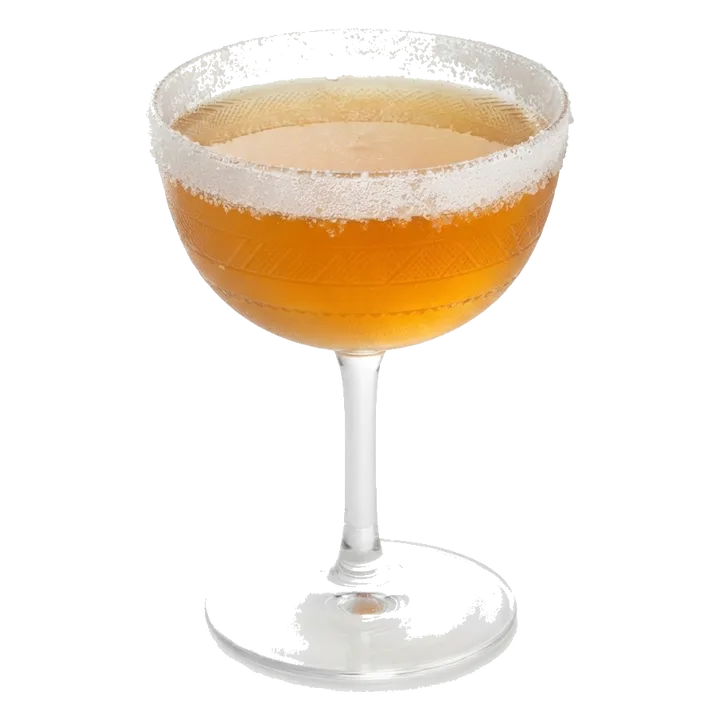
Sidecar
4.2 422 ratings
Ingredients
How to make
Serve in a coupe glass
Prepare
- 1 Select and pre-chill a COUPE GLASS.
- 2 RIM glass with sugar (moisten the outside edge with orange juice and dip into sugar).
- 3 Prepare garnish of lemon zest twist.
Method
- 4 SHAKE all ingredients with ice.
- 5 FINE STRAIN into chilled glass.
Garnish
- 6 EXPRESS lemon zest twist over the cocktail and use as garnish.
Made it?
How did it pour?
Rate this drinkWith an account you can score a drink once you have poured it and keep a note on how you made it. Your score and your note are yours alone; share your ingredient list if you want to, and other members see how you pour it.
Flavour profile
19.1% alc./vol. · 1.4 standard drinks · 154 calories
History
Cognac is complemented by lemon and orange zest. Those who prefer a sweeter drink can add a sugar rim, a common practice for the Sidecar. The proportions of this cocktail are as debated as its origins. The earliest published recipes, from Robert Vermeire's 1922 Cocktails: How to Mix Them and Harry MacElhone's 1922 ABC of Cocktails, use equal parts: 1 part brandy, 1 part triple sec, and 1 part lemon juice. This recipe remains popular, perhaps due to its simplicity. David A. Embury, in his 1948 Fine Art of Mixing Drinks, critiqued the equal parts Sidecar, stating, "This is the most perfect example of a magnificent drink gone wrong". He drew a parallel to the Daiquiri, suggesting, "Essentially the Side Car is nothing but a Daiquiri with brandy in the place of rum and Cointreau in the place of sugar syrup or orgeat." Embury then proposed his own ratio for a Daiquiri: 2 parts brandy, ½ part triple sec, and ¼ part lemon juice. In The Savoy Cocktail Book (1930), Harry Craddock's recipe called for 2 parts brandy, 1 part triple sec, and 1 part lemon juice. Some attribute the equal parts recipe by MacElhone and Vermeire to the "French school," while Craddock's 2:1:1 formula is considered to be from the "English school." A previous recipe suggested a 6:3:2 ratio (45ml brandy, 22.5ml triple sec, and 15ml lemon juice), which offered a middle ground between The Savoy and equal parts. However, the Sidecar is improved by adding a spoonful of sugar syrup to enhance the triple sec's sweetness, reducing the liqueur, and increasing the lemon juice, as shown in the current recipe. An even better alternative is to replace the sugar syrup with Pineau des Charentes and follow the provided Sidecar recipe.
David A. Embury, in his 1948 book The Fine Art of Mixing Drinks, stated about the Sidecar's origin: "It was invented by a friend of mine at a bar in Paris during World War I and was named after the motorcycle sidecar in which the good captain customarily was driven to and from the little bistro where the drink was born and christened." Embury did not identify the bar, but it is often assumed to be Harry's New York Bar, with Harry MacElhone credited as the creator. However, in his own 1922 ABC of Cocktails, Harry attributed the cocktail to Pat MacGarry, described as "the Popular bar-tender at Buck's Club, London." Later editions of his ABC of Cocktails seem to suggest he took credit for it himself. The fact that MacElhone worked with Malachi "Pat" MacGarry at Buck's Club shortly after its opening in June 1919 might be relevant. The assertion that MacGarry created the Sidecar is further supported by the first printed recipe found in Robert Vermeire's Cocktails How To Mix Them, published in May 1922, a few months before Harry MacElhone's ABC of Cocktails. Side-Car. Fill the shaker half full of broken ice and add: 1/6 gill of fresh Lemon Juice. 1/6 gill of Cointreau. 1/6 gill of Cognac Brandy. Shake well and strain into a cocktail-glass. This cocktail is very popular in France. It was first introduced in London by MacGarry, the celebrated bar-tender of Buck's Club. As with many classic cocktails, the exact creator and namer of the Sidecar are likely to remain unknown. However, it appears MacGarry created it in London, and Harry MacElhone later popularized it at his Parisian bar. Vermeire's 1938 French-language edition of his book lends credence to the drink's French connection, noting that the south of France was its home. There is no evidence to support the claim that the Sidecar was "invented at the Carlton Hotel in Cannes."