
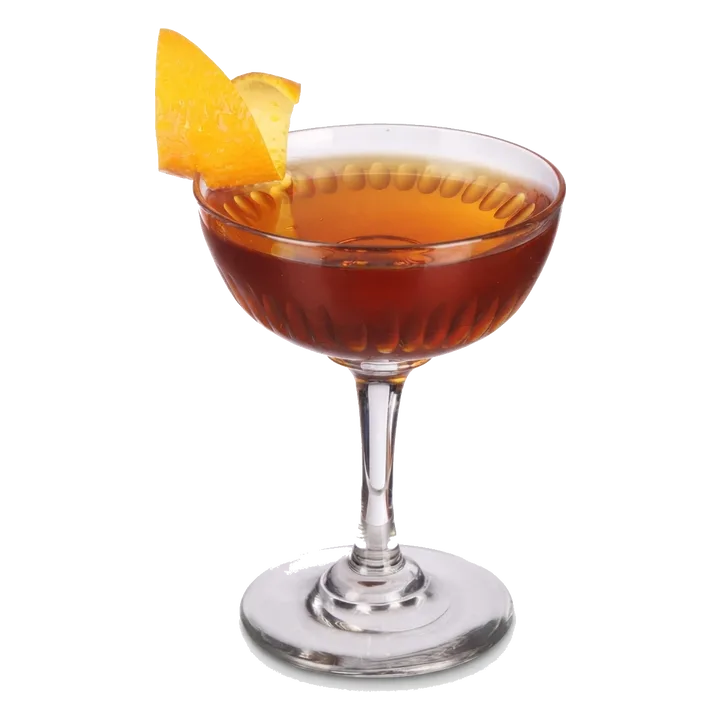
Martinez
5.0 206 ratings
Ingredients
How to make
Serve in a coupe glass
Prepare
- 1 Select and pre-chill a COUPE GLASS.
- 2 Prepare garnish of orange zest twist.
Method
- 3 STIR all ingredients with ice.
- 4 STRAIN into chilled glass.
Garnish
- 5 EXPRESS orange zest twist over the cocktail and use as garnish.
Made it?
How did it pour?
Rate this drinkWith an account you can score a drink once you have poured it and keep a note on how you made it. Your score and your note are yours alone; share your ingredient list if you want to, and other members see how you pour it.
Flavour profile
26.7% alc./vol. · 1.8 standard drinks · 156 calories
History
The choice of genever is crucial for this distinguished cocktail. The recipe presented is based on a medium-dry, rounded, and complex genever, such as Rutte Old Simon or Bokma Oude, which imparts an underlying bready note. This is then brightened by the zestiness of the orange curaçao. For a higher maltwine, or a more old-school genever like Old Duff, equal parts genever and rosso vermouth are recommended. However, Philip Duff himself suggests: 30ml (1oz) Oude genever 50ml (1⅔oz) Rosso (sweet) vermouth 5ml (barspoon) Orange curaçao 1 dash Aromatic bitters
It is generally agreed by cocktail historians that the Martinez evolved from the Manhattan and preceded the Martini, with its emergence placed around the 1860s or early 1870s. The earliest known recipe for a Martinez appears in O.H. Byron's 1884 publication, The Modern Bartender, which supports this timeline and its relationship to the Manhattan, as Byron lists the Martinez as a variation of the latter. Manhattan Cocktail, No. 2. 2 dashes Curacoa. 2 " Angostura bitters. ½ wine-glass whisky. ½ " Italian vermouth Fine ice ; stir well and strain into a cocktail glass. Martinez Cocktail. Same as Manhattan, only you substitute gin for whisky. Byron's description of the Martinez as being "Same as Manhattan, only you substitute gin for whisky" is made more complex by the fact that two different Manhattan recipes are presented on the same page: one calls for 'dry' French vermouth and gum syrup, while the other uses 'sweet' Italian vermouth and curaçao. However, considering Byron's placement of the Martinez directly below the Manhattan recipe that uses Italian vermouth, and the greater prevalence of sweet vermouth at the time compared to the drier French variety, it is plausible that Byron's Martinez was made with Italian vermouth. Furthermore, the type of gin used is a point of consideration. When Byron mentions gin, is he referring to English old tom gin or Dutch genever? Drier English gins, such as London dry, were not widely available in America until the 1890s. In fact, very little English gin was distributed in America during the nineteenth century. David Wondrich, in his 2015 book Imbibe, states, "In the 1850s, the port of New York was clearing between 4,500 and 6,000 120-gallon pipes of genever a year (roughly equal to some 2.7 to 3.6 million 750-millilitre bottles) as opposed to 10 to 20 pipes of English gin. Moreover, if distillers' handbooks are to be believed, domestic American gins were modelled on the heavier, maltier Dutch style rather than the lighter, cleaner English style." If the Martinez indeed originated as a variation of the whiskey-based Manhattan, then Dutch genever, rather than just availability, would have been the more probable gin choice for the first Martinez. The softer, rounder, and notably malty character of the malt-wine heavy Dutch genevers of that era more closely resembles whiskey, the original ingredient, than the sharper, piney English old tom gins. It is likely that the first Martinez was created by a bartender who substituted a malty genever for whiskey in a simple variation. The early era of American cocktail bartending was, naturally, dominated by the notable 'Doctor' Jerry Thomas, who published the first known bartender's guide in 1862, preceding Byron. Significantly, Thomas omitted the Martinez from both the first edition of his book and its 1876 second edition. It remains unknown whether this omission was due to his unfamiliarity with the cocktail, its non-existence at the time, or an oversight. However, claims that he invented the Martinez appear unlikely, given his propensity for self-promotion; he would likely have publicized such an achievement, leaving a documented record, similar to the case of the Tom & Jerry, a drink he controversially did not create. In the 1862 edition of Jerry Thomas' book, he includes 17 gin drinks, with only one, 'Punch by Soyer', specifying the type of gin as "old gin". As previously noted, due to the limited availability of English gin at that time, it is presumed that when Thomas referred to "gin", he was actually referring to genever, which would have been 100% malt wine genever back then. The Martinez Cocktail does appear in the 1887 edition of Jerry Thomas' The Bar-tender's Guide (published posthumously two years after his death), specifying "1 pony of Old Tom gin." Apart from the base spirit, the recipe is remarkably similar to the Manhattan Cocktail recipe on the facing page. Martinez Cocktail. (Use small bar-glass) Take 1 dash Boker's bitters. 2 dashes of Maraschino. 1 pony of Old Tom gin. 1 wine-glass of Vermouth. 2 small lumps of ice. Shale up thoroughly, and strain into a large cocktail glass. Put a quarter slice of lemon in glass, and serve. If the guest prefers it very sweet add two dashes of gum syrup. Regrettably, neither Jerry Thomas' Manhattan nor Martinez recipes specify whether to use Italian or drier French vermouth, though Italian 'sweet' vermouth was considerably more common in America at the time. This ambiguity regarding dry or sweet vermouth is not resolved in the next known appearance of a cocktail specifically named Martinez in Stuart's Fancy Drinks from 1896. In fact, this appears to be a direct adaptation of O H Byron's 1884 book, featuring nearly identical recipes. The subsequent appearance of the Martinez (on page 55 in the 1905 Consolidated Library of Modern Cooking and Household Recipes, volume 5, by Christine Terhune Herrick and M. Harland) also fails to clarify the vermouth question but continues the trend of using old tom gin over Dutch genever. If genever was part of the original Martinez, it seems to have rapidly lost favour in this and other American cocktails as old tom and subsequently London dry gins gained popularity. It is noteworthy that this 'Consolidated Library' recipe closely resembles Jerry Thomas' recipe mentioned earlier and also the Manhattan recipe preceding it in the same book. Martinez Cocktail. Shake up well, and then strain into a large cocktail glass 1 dash of Boker's bitters, 2 dashes of maraschino, 1 pony of Old Tom gin, 1 wine-glassful of vermouth, 2 small lumps of ice. Add a slice of lemon, and gum syrup if desired, as in the last recipe. Vermeire's 1922 Martinez In London, bartender Robert Vermeire's 1922 book, Cocktails: How to Mix Them, includes multiple Martinez recipes. Martinez Cocktail. The Martinez Cocktail is very similar to the Manhattan Cocktail, but gin is used instead of Whiskey. Fill the bar glass half full of broken ice and add: 2 dashes of Orange Bitters 3 dashes of Curacao or Maraschino ¼ gill of Old Tom Gin ¼ gill of French Vermouth Stir up well, strain into a cocktail-glass, add olive or cherry to taste, and squeeze lemon peel on top. This drink is very popular on the Continent. In England the Martinez Cocktail generally contains the following ingredients: 2 dashes of Orange Syrup 2 dashes of Angostura Bitters ¼ gill of Plymouth Gin ¼ gill of French Vermouth The whole stirred up in ice in the bar glass, strained into a cocktail-glass with lemon-peel squeezed on top. Olive or cherry according to taste. Third Degree The Third Degree is a Martinez Cocktail (Continental style) with a dash of Absinthe and an olive, but 2/6 gill of Gin and 1/6 of French Vermouth should be used. Fourth Degree The Fourth Degree is a Martinez Cocktail (Continental style) with a dash of Absinthe and a cherry, but ¼ gill of Gin, 1/8 gill of French Vermouth, 1/8 gill of Vermouth should be used.