
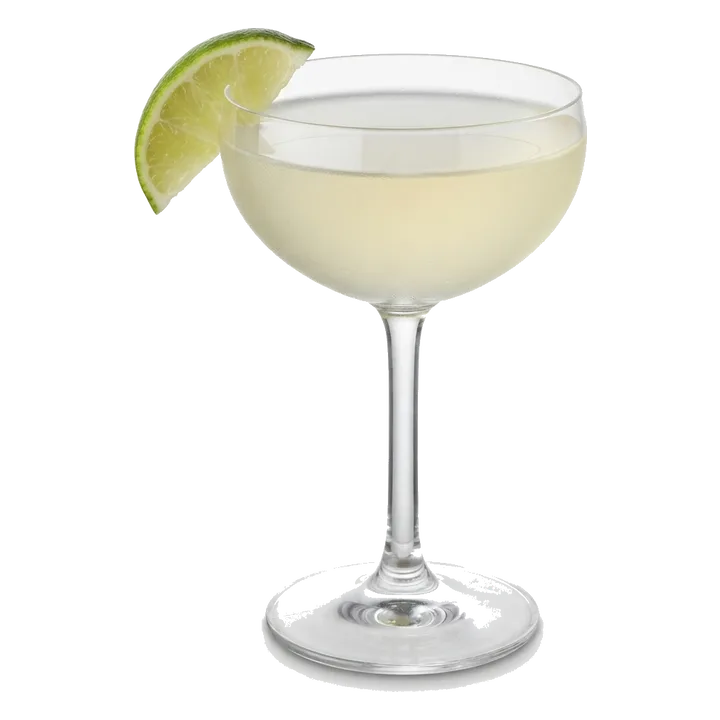
Gimlet
4.8 111 ratings
Ingredients
How to make
Serve in a coupe glass
Prepare
- 1 Select and pre-chill a COUPE GLASS.
- 2 Prepare garnish of lime zest twist and lime wedge.
Method
- 3 SHAKE all ingredients with ice.
- 4 FINE STRAIN into chilled glass.
Garnish
- 5 Express lime zest twist over cocktail and discard.
- 6 Garnish with a lime wedge.
Made it?
How did it pour?
Rate this drinkWith an account you can score a drink once you have poured it and keep a note on how you made it. Your score and your note are yours alone; share your ingredient list if you want to, and other members see how you pour it.
Flavour profile
19.2% alc./vol. · 1.4 standard drinks · 154 calories
History
Traditionally, the Gimlet consists of equal parts gin and lime cordial, stirred in the serving glass, with ice being optional but recommended. This British Navy cocktail predates modern mixology and refined London dry gins. To enhance flavor, a touch of genever is added alongside the gin. The original recipe, heavy on lime cordial, is excessively sweet. Charles H. Baker Jr.'s 1939 Gimlet recipe suggests reducing the cordial. Inspired by Charles Schumann's 1995 Gimlet, fresh lime and lemon juices are incorporated to balance the sweetness while maintaining the drink's signature lime cordial profile. Some mistakenly omit lime cordial, creating a drink that is essentially a lime Gin Sour, not a Gimlet. A Gimlet, by definition, requires lime cordial. While typically stirred, the addition of fresh citrus juice means the cocktail may not be perfectly clear, even when stirred. Therefore, following Harry Craddock's guidance in his 1930 Savoy Cocktail Book, shaking is recommended to invigorate the drink.
In the 17th century, English sailors learned that consuming citrus fruit could prevent scurvy, a prevalent illness on ships. However, even with John Woodall (1570-1643), an English military surgeon for the British East India Company, recommending citrus fruit as part of sailors' rations, its widespread use did not occur. James Lind, a Scottish surgeon, performed clinical experiments in 1747 that demonstrated citrus possessed an antiscorbutic effect. Nevertheless, he thought scurvy stemmed from various factors, notably poorly digested and decaying food, contaminated water, excessive labor, and humid living environments; consequently, he did not propose citrus as the only solution. Naval officers and surgeons observed that citrus juice prevented scurvy, which prompted Rear Admiral Alan Gardner to mandate a daily ration of lemon juice aboard the Suffolk during a 23-week, non-stop journey to India in 1794. This measure prevented any serious scurvy outbreak. This specific voyage, combined with Lind's earlier discoveries, persuaded the Admiralty to advise the routine distribution of lemon juice throughout the fleet. However, adequate fruit supplies for this only became available after 1800. After the advantages of consuming citrus juice became widely recognized, British sailors drank such substantial quantities, especially lime juice, frequently blended with their everyday ration of rum and water ('grog'), that they earned the affectionate moniker 'Limeys'. Scurvy is now known to be caused by a Vitamin C deficiency, and it is this vitamin present in citrus fruit that helps to prevent the illness. The 1867 Merchant Shipping Act mandated that all British ships carry lime juice rations for their crews. This fruit juice was preserved with the addition of 15% rum; however, in 1867, Lauchlin Rose, who owned a shipyard in Leith, Scotland, patented a method for preserving fruit juice using sugar instead of alcohol. To broaden his product's attractiveness, he bottled the concoction appealingly and called it 'Rose's Lime Cordial'. According to legend, while ratings consumed rum, their officers preferred gin, and thus, they naturally combined Rose's lime cordial with gin to create Gimlets. It is therefore suggested that the Gimlet's origin arose from circumstance rather than inventive ingredient blending, and an un-chilled (given the absence of ice) 50-50 Gimlet is described as tasting accordingly. Yet, when stirred with ice and blended in more harmonious ratios, the outcome is delightful. Story behind the name Regarding the name, a 'gimlet' was a small tool employed to tap barrels of spirits aboard British Navy vessels, which might be the source of the cocktail's designation. An alternative account refers to a naval doctor, Rear-Admiral Sir Thomas Desmond Gimlette (1857-1943), who is reported to have blended gin with lime 'to help the medicine go down'. While plausible, this claim lacks corroboration in his obituary in The Times (6th October 1943) or his entry in Who Was Who (1941-1950), and it is suggested that many naval doctors likely offered similar advice during that era. Vintage Gimlet recipes & references Vintage Gimlet recipes and references include Harry MacElhone's 1923 publication, *Harry of Ciro's ABC Of Mixing Cocktails*. This book features recipe number 99: "99. Gimlet. ½ Coates' Plymouth Gin, ½ Rose's Lime Juice Cordial. Stir, and serve in same glass. Can be iced if desired. A very popular beverage in the Navy." Harry Craddock's *The Savoy Cocktail Book*, published in 1930, contains listings for both a "Gimlet Cocktail" and a "Gimblet Cocktail". The *Savoy* offers the following for the "GIMBLET COCKTAIL": "GIMBLET COCKTAIL. ¼ Lime Juice. ¾ Dry gin. Shake well and strain into medium size glass; fill up with soda water." And for the "GIMLET COCKTAIL": "GIMLET COCKTAIL. ½ Burrough's Plymouth Gin. ½ Roses Lime Cordial. Stir, and serve in same glass. Can be iced if desired" David A. Embury's 1948 book, *The Fine Art of Mixing Drinks*, includes remarks in its "Roll Your Own" section (page 131). There, David A. Embury states: "...the Gimlet is a Gin Rickey and is made with sugar, lime juice, gin, and carbonated water. It is served in a Delmonico or Sour glass. It is also served as a cocktail, omitting the carbonated water." Further mention appears in Raymond Chandler's 1953 novel, *The Long Goodbye*. Within the novel, the following description of the drink is provided: "The bartender set the drink in front of me. With the lime juice it has a sort of pale greenish yellowish misty look. I tasted it. It was both sweet and sharp at the same time. The woman in black watched me. Then she lifted her own glass towards me. We both drank. Then I knew hers was the same drink."