
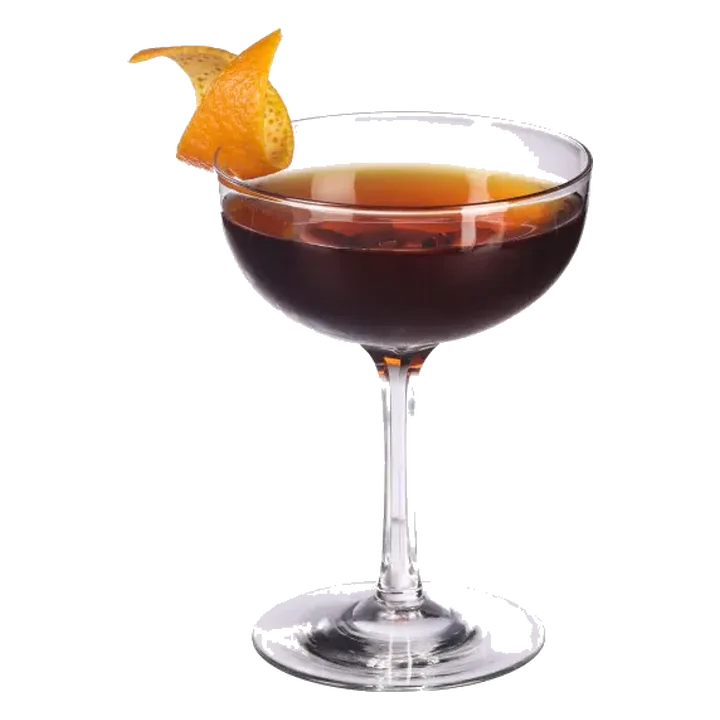
Armour
4.4 26 ratings
Ingredients
How to make
Serve in a coupe glass
- 1 THROW (or stir) all ingredients with ice and strain into chilled glass.
Made it?
How did it pour?
Rate this drinkWith an account you can score a drink once you have poured it and keep a note on how you made it. Your score and your note are yours alone; share your ingredient list if you want to, and other members see how you pour it.
Flavour profile
12.3% alc./vol. · 0.8 standard drinks · 107 calories
History
A Bamboo using rosso (sweet) vermouth instead of dry vermouth, creating a cocktail more digestivo than aperitivo.
The Armour cocktail made its debut in the 1898 book Cocktails, presented anonymously with a recipe calling for equal parts sherry and Italian vermouth, along with orange bitters. Armour Cocktail. FINE ice in a mixing-glass, three dashes orange bitters, half a jigger sherry, half a jigger Italian vermouth. Mix, strain into cocktail-glass. Add a piece of orange peel. In his 1900 publication, Modern American Drinks, George J. Kappeler reiterated this equal parts formula, including dashes of orange bitters. Cocktail books published up to 1930 followed suit, with Charlie Roe & Jim Schwenck's The Home-Bartender's Guide and Song Book in that year reaffirming the recipe and offering a hint at the drink's name origin: "the stockyards out in Chigago." ARMOUR COCKTAIL. You need armor to withstand this one. Back of the stockyards out in Chicago, they used to drink one of these before breakfast, and go out and look for a policeman to beat up. P. S. – They still do it. Fine ice in mixing glass Three dashes of orange bitters Half a jigger of sherry Half a jigger of Italian Vermouth Mix, strain into cocktail glass Add a piece of orange peel In 1901, the cocktail's Chicago connections were further solidified in Albert Stevens Crockett's Old Waldorf Bar Days. The "Concerning the Curriculum" section, which details the naming of cocktails marked with an asterisk on subsequent pages, includes a significant sentence on page 102: "For example, take the Armour; called after a well-known Chicago patron of the establishment." ARMOUR* Two dashes Orange Bitters One-half jigger Sherry One-half jigger Italian Vermuth Stir; strain The "Stockyards out in Chicago" refer to Chicago's Union Stock Yards, which were the preeminent American center for meat processing and the location of one of the world's largest slaughterhouses. Albert Stevens-Crockett explains that the cocktail was named in honor of a "well-known Chicago patron of the Waldorf-Astoria." This patron was likely Jonathan Ogden Armour (1863-1927), the American meatpacking magnate and president of Armour & Company, the largest meat processor in the United States.
Also known as Duke of Marlborough Cocktail